Sunday, December 11, 2011

Stabilization Wedges/game


This site offers an introduction to the concept of wedges and the game. There are great visuals that depict the idea of the concept, and the different strategies to complete the stabilization triangle.

This website is informative about ways to practice agriculturally sustainable habits. It focuses on ways to increase sustainability when using certain methods. Also it shows that if certain crops are harvested the sustainability of the agriculture will increase. Additionally different types of animals on a farm can increase sustainability.

This site offers a great introduction to carbon capture and storage which is one of the possible wedges that can be used to complete the triangle. It gives a run down of places that have used this for experimentation and what they came up with for results. It also explains the process of carbon capture in a detailed matter.

This site gives a description of compact fluorescent light bulbs that account for the consumer efficiency wedge. It turns out that when changing to a CFL you will save about $50 on each lifetime of the bulb compared to a regular filament light bulb. There are some disadvantages when changing them; you must make sure that 2 bulbs in a fixture are of the same wattage.

This site also covers one of the wedges in the stabilization triangle which is gas fired power plants. The site discusses the advantages of gas fired plant compared to a coal fired plant. It also discusses gas fired reciprocating engines which was new to me.

Articles:
Christiansen, Jen. "Managing The Climate Problem." Scientific America (2006): 52-57. Print.
This article gives an overview of the idea of the stabilization wedges and how they can be used to keep a cap on our emissions for the future. It shows figures of what the projection of the wedge idea will be outputted. It gives detailed information on most of the options for wedges that would cap our emissions. It also shows the distribution of wealth around the world and relates it to the amount of emissions outputted.

Hotinski, Roberta. "Stabilzation Wedges." Carbon Mitigation Institute (2009). Print.
This article comes with complete directions on how to play the stabilization wedge game in which we played in class. Also it gives a detailed account of all of the possible wedges that would be used to complete the stabilization triangle. It is the most collective and informative information that we got on the topic. There are so many ways that you can complete the triangle so there are endless combinations of alternative energy uses.
Figures:
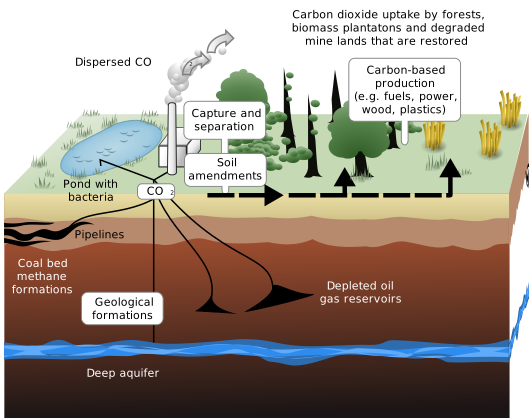

File:Carbon sequestration-2009-10-07.svg
The process of carbon capture and storage. (http://www.ornl.gov/info/ornlreview/v33_2_00/research.htm)

The Wedges Concept
The projection for stabilization wedges. (http://www.wri.org/chart/wedges-concept)


Carbon trading/taxing


This is the EPA’s site that explains the concept of cap and trade. The main idea seems to promote this system because I feel like the government would tax the CO2 emission amounts. It also discusses when this system would be appropriate to be politically and economically viable.

This website offers a video showing the system of cap and trade. It portrays that if we want to do something about consumption that we have to put a limit on the amount of resources that they use.

The site offers an explanation of the proposed cap and trade program that was enacted when the clean air act was put in place during the 1970’s. It shows details of the projection for the program.

This site offers a very detailed description of the cap and trade system, including its benefits, downfalls and potential for the future economy. It explains the whole system in which you could trade carbon credits globally.

This site is great because it offers a broader view from the consumer of what the system of cap and trade is all about. It relates to the common person well, while providing useful information.

Articles:
Broder, John M. "Obama Opposes Trade Sanctions in Climate Bill." Newsweek (2009). Newsweek.com. Web.
This article reports about president Obama’s opposition of the proposed cap and trade bill, that would in reality put a cap on the amount of emissions outputted by national companies. Obama feels that there is a should be a different way of doing this instead of posting tariffs on the business industry. He feels that when the economy has returned to its normal state that it may be more equitable.

LeonHardt, David. "A Climate Proposal Beyond Cap and Trade." Newsweek (2010). Www.newsweek.com. Web.
Instead of using the system of cap and trade Michael Greenstone proposes that we use another way of limiting carbon emissions. Although he supports the bill of cap and trade and wants it to be put back on the bill for next year, he feels that it would not be efficient. Instead he simply wants to charge for the amount of carbon that you emit, eliminating the trade part of the system. He feels that it would force companies to use parts f their budgets to find cleaner ways of powering their companies.

Figures
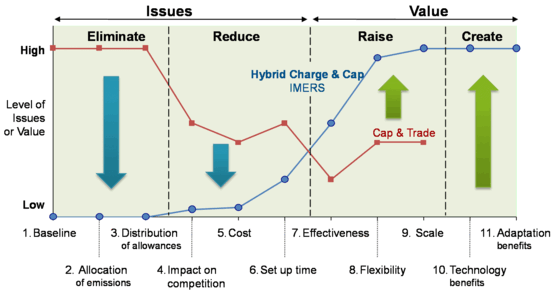
The effects on the economy with a cap and trade system. (http://imers.org/files/img/hybrid-charge-and-cap-vs-cap-and-trade.gif)

Graph representing how the wealth will be distributed in a cap and trade system. (http://assets.theatlantic.com/static/mt/assets/conor_clarke/cap%20and%20trade%20share%20by%20income.png)

Nuclear Energy


This site gives a great overview of nuclear power showing statistics, risks and benefits. It shows how the nuclear process works, the pros, the cons and insight to if it is the right alternative energy source. Great all around resource describing nuclear power.

This site is from an organization that offers much information on the current nuclear energy situation. It gives information on the building of new plants and how long it takes to construct a functional plant. It also keeps you up to date on politics associated with nuclear energy.


This site offers good basic information on how nuclear energy works. Also it goes deeper in discussing how nuclear fusion and fission work, to create energy that can be used to make sustainable and clean energy.

In this site there is informative text that reveals what nuclear energy is derived from. It explains the environmental impacts investing in nuclear energy. It also explains about the nuclear waste created from the process of nuclear energy and the air emissions.

In this resource it describes the plan in which president Obama enacted to support growth of our nuclear energy program. He plans to build a number of new nuclear reactors that will be able to provide clean energy supply for our country for up to twenty years.

Articles:
Farmer, Doyne J. "A US Nuclear Future?" Nature (2010): 391-93. Macmillian Publishers. Web.
This article looks into nuclear power and if it is a viable energy source for our country in the future. Obama announced that he wants to boost funding for this energy source, which is a very controversial topic because there are lots f opposes of this energy source due to the safety concerns that take place with a nuclear reactor spill. This article gives two standpoints of the situation between a supporter and an opposed of Nuclear. Both have great points of why or why we should not use this energy source in the future.

Charles, Dan. "Spinning a Nuclear Comeback." Science (2007). AAAS. Web.
This article shows that worldwide lots of countries are using nuclear power to produce electricity and energy for a decent portion of their populations. Leading the way in this trend is Russia with centrifuges. Currently The USA, Brazil, France and Iran are under construction of plants that take about 20 years to construct due to the permits and licenses that you need to construct a plant. The only thing about nuclear is that it takes 20 years to build a reactor and then is only safe to use for 20 years. This makes it hard to keep up with their construction.


A picture showing locations of nuclear power plants in the USA. (http://www.solcomhouse.com/images/Enernuc.gif)

Carbon Capture


This site gives a great overview of the carbon capture and storage technology from the world renowned MIT. It provides a list of current projects that are using carbon capture and storage. It also includes a list and map of areas that are proposed carbon capture and storage sites.

This site gives a great introduction to the carbon capture and technology behind it. It explains the different methods used in the technology. Also it explains why we need to implement this technology into our society.

This site offers an informative look into the technology of carbon capture and storage. It also explains the different types of carbon capture and sequestrian that we have today. As well as a predicted start up costs and problems with implementing technology.

This site explains carbon capture and storage with great understanding. It begins by teaching the process and then explains the different methods that we have to do this. It also provides transporting concerns and methods for the carbon once it is captured.

This page has a really interesting way of portraying information, in which it gives you an overview of the topic and then enables you to click on details tab and learn more about the topic. It answers many questions about carbon storage doing this efficiently.

Articles:
Schiermeier, Quirin. "Putting the Carbon Back: The Hundred Billion Tonne Challenge." Nature 442.7103 (2006): 620-23.

The article from nature journal compares how the use of carbon capture has worked for European towns, such as Ketzin, Germany in which there is a carbon capture plant is being used. It analyzes the effects of the technology and then gives a cost analysis of using the technology.

Jones, Nicola. "Climate Crunch: Sucking It up." Nature 458.7242 (2009): 1094-097.

The article explains the need for the use if carbon capture in the world and shows a useful graph of what each countries carbon emissions are in the world. It offers the idea that has been proposed and has no technological reality currently, in which we could use “brooms” that would act like filters in the atmosphere to capture carbon dioxide.
Figures:
meic.org, shows different ways in which we can use the technology of carbon capture.

wri.org, exhibits a useful diagram that shows how the technology is used, and what depths we would be storing the excess carbon in the atmosphere in the ground.  

Geothermal Energy


This site is a useful source that provides you information on installing a geothermal system for your home. It explains the basics of the unit in your home and the best conditions for the application. There are benefits discussed about the product for your home.

In this site there is good background information on the areas that can be best used for geothermal energy, like Greenland for example. It gives the basics of the workings of a geothermal system. Also it gives further information on geothermal heat pumps, electricity production and the direct use from a geothermal system.


This site is a useful source that provides you information on installing a geothermal system for your home. This site is home to a geothermal company. It explains the basics of the unit in your home and the best conditions for the application.

This site is very interesting because it shows places on the earth graphically that would be better for the use of geothermal energy. It provides a slideshow and video that is informative about the topic and has links to “ask experts” about the topic if you have any questions.

This site discusses the very few, but disadvantages of geothermal energy. It gives good insight on that it really depends on where you are located to get all of the benefits that geothermal energy offers. Lots of places that would be good for the energy source is un buildable.


Articles
Giardini, Domenico. "Geothermal Quakes Must Be Faced." Go.nature.com/rk5jgK. Macmillian
This is a very interesting article that describes the developments of geothermal systems being used in Europe, that once made will be the biggest and most efficient systems on the planet. It also describes the risks of seismic events when using a geothermal system, which is the biggest problem with the use of these systems. The author describes the story of Basel, Switzerland, and the problems that they are having.

This article gives a great detailed introduction to the systems of geothermal and how they can be used as a clean alternative energy source. It brings you through the steps needed to set up the unit and how to capture the energy produced by this process. It shows great figures to help you learn the concept and also tells about the future of geothermal systems, like enhanced versions of the existing product.

Biofuels


This site is great because it gives a description of what biofuels are defined as, using material from living or dead organisms. It contains several articles relating to the topic that are very informative and other tools such as video links other resources. In addition it covers more than biofuels.

This site has a nice page describing how algae can be used as a biofuel. It discusses the advantages and disadvantages of this process and how much we could depend on it as an alternative energy source. It compares the amount of energy that algae can produce compared to other sources like palm oil, sugarcane and corn.

Although this site is considered to be bad for some, this site provides a great outline of what biofuels are and categorizes different types of biofuels. In addition it gives detail descriptions of the different types of biofuels and what there projected uses will be in our future.

This site gives you a great run down on Ethanol as a biofuel. It covers all the different types of ethanol being used like E-85 and the 10% used in our gasolines. Also it gives insight on how we produce the biofuel and figures showing how much farmland we would need to rely solely on ethanol. It provides a resource that informs you on how your automobile will run on ethanol gas.

This site tells you what the pros and con’s are of biofuels. From reading this it seems that they both equal out. Although in most cases they give your car worse gas mileage and use the same amount of resources as before.

Articles:
Schrag, Dan. "Coal as a Low-carbon Fuel?" Nature (2009). Macmillian Publishers. Web.
This article describes the process that could be the future of our fuel produced for jets, trucks and trains. This process is making fuel from coal, in which we have a great supply of in the USA. The only thing is that when making this fuel from coal it is the dirtiest process that would not be environmentally viable unless we use some carbon capture to counteract the effects.

Phillips, Matthew. "A Major Alternative-Energy Moment in Texas." Newsweek (2010). Print.
This article describes president Obama’s stance on the switch to other alternative fuels that could be used for transportation and heating of homes. He knows that we need to pursue this technology in order to prosper into the next generation and generations to come.
Figures:

Fossil fuels and peak oils week 3


This site gives good information in the form of graphs and tables estimating the amount of reserves we have left and how long we can keep depending on oil. It also provides recent articles and news about oil supplies and plans to become sustainable.

This is very useful because it gives you an up to date approximation of the world and USA population. In addition it is a catalogue of the business census and economic indicators.

This site offers an inside look on what the process of oil drilling entails. This is good information to know from locating the oil using infrared technology, to drilling the location and then extracting the crude oil. Also you can read about how they make different types of oil products through separation of the crude oil.


This site is a worldwide blog that discusses the possible amounts of oil left on the earth and how long it will take for us to run out. There are several different scenarios discussed with different factors contributing to when we will actually be dry of oil.

In this site there are mathematical, historical, graphical and practical predictions of the amount of oil left and how long it will last us. It includes predictions from Einstein to mathematical calculations by modern scientists. There are useful figures in this page as well.

Articles:
Kerr, Richard. "World Oil Crunch Looming?" Science (2008). Www.sciencemag.org. Web.
This article talks about the current oil usage and the usage of fossil fuels in our past. It says that it took 140 years for us to consume our first trillion barrels of oil and that is expected to be used in a lot shorter time than of before. It projects that the world will be out of oil within the latest 50 years, depending on our consumption patterns, that are expected to increase through 2030. It gives graphs of the projected oil consumption, and gives insight on what Opec is all about, which is make money.

Kerr, Richard. "The Looming Oil Crisis Could Arrive Uncomfortably Soon." Science (2007). Www.sciencemag.org. Web.
In this article it is focusing on the problem that we are faced with, which is oil on the earth running out and us having to find another resource to provide us with all our lifestyles that we have grown so used to. He predicts three different scenarios of when Oil will reach its peak, depending on if we have high or low resources.

Friday, September 23, 2011

Second week resources

After looking at this website I found it alarming that 50% of business lack a sustainable strategy. The site includes lots of statistics on what businesses need to do in order to make a change to a greener operation. It shows projections of what will happen to certain businesses if they do not make the change.

The site is the home of the UNEP, which is the United Nations Environment Program. This site is full of information that assists governments and business for the green initiative. It keeps them informed about current issues and tries to make mandates on certain products to help clean up the environment.

This site is actually from a college class in Ontario, but I found it very useful. It gives an overview of what green economics are and then gives much information, just like a class about green economics and ecological economics. Additionally there are resource articles about the current issues with our economy.

This site is a good resource for the building green facilitation. It offers advantages of building green and also provides statistics that show our current use of energy the way we build things now. It shows that if we build green it will be advantageous to our health, improve air and water quality and create new jobs.

Articles
McKibben, Bill. "Breaking the Growth Habit." Scientific America (2010): 61-65.
This article describes a great way to conserve energy and think positively about the future. It suggests that instead of investing in the same technology that pollutes the environment, to invest in green technology and think locally when purchasing products and creating energy. He thinks that rating locally grown food and taking advantage of local energy sources.

Parry, Martin. "Climate Change Is a Developmental Issue, and Only Sustainable Development Can Confront the Challenge." Earthscanjournals.com. 2009. Web.
This source gives a good look at what will happen if richer countries change technology in order to have clean energy sources. This would not allow proper development for pooper countries that could not afford this new and expensive technology. It does make the point prevalent that we do need to make changes so our climate does runaway on us.


A figure that represents what needs to be done in the economy to yield a sustainable society. (greeneconomics.net)

A figure that represents the amount of money needed to support the switch to a sustainable economy. (http://www.environmentalleader.com)

After looking at this website I found it alarming that 50% of business lack a sustainable strategy. The site includes lots of statistics on what businesses need to do in order to make a change to a greener operation. It shows projections of what will happen to certain businesses if they do not make the change.

The site is the home of the UNEP, which is the United Nations Environment Program. This site is full of information that assists governments and business for the green initiative. It keeps them informed about current issues and tries to make mandates on certain products to help clean up the environment.

This site is actually from a college class in Ontario, but I found it very useful. It gives an overview of what green economics are and then gives much information, just like a class about green economics and ecological economics. Additionally there are resource articles about the current issues with our economy.

This site is a good resource for the building green facilitation. It offers advantages of building green and also provides statistics that show our current use of energy the way we build things now. It shows that if we build green it will be advantageous to our health, improve air and water quality and create new jobs.

Articles
McKibben, Bill. "Breaking the Growth Habit." Scientific America (2010): 61-65.
This article describes a great way to conserve energy and think positively about the future. It suggests that instead of investing in the same technology that pollutes the environment, to invest in green technology and think locally when purchasing products and creating energy. He thinks that rating locally grown food and taking advantage of local energy sources.

Parry, Martin. "Climate Change Is a Developmental Issue, and Only Sustainable Development Can Confront the Challenge." Earthscanjournals.com. 2009. Web.
This source gives a good look at what will happen if richer countries change technology in order to have clean energy sources. This would not allow proper development for pooper countries that could not afford this new and expensive technology. It does make the point prevalent that we do need to make changes so our climate does runaway on us.


A figure that represents what needs to be done in the economy to yield a sustainable society. (greeneconomics.net)

A figure that represents the amount of money needed to support the switch to a sustainable economy. (http://www.environmentalleader.com)

First Week sources

What is Sustainability?
Websites:
This website gives a nice overview of what the EPA is currently doing to try and get people to be sustainable and lots of information on different sources of alternative energy. In addition it gives insight on what people can do to lead a sustainable lifestyle.

This website provides lots of new breakthrough news and technology about sustainability, that we may be able to use in the future for alternative resources. It contains lots of studies with current technology to get optimum efficiency.

This site gives an in depth look on how we can use tidal energy to spin a turbine and create electricity. It provides mathematical figures to show how effective tidal energy is. There are also studies that show the potential of tidal energy because it is one of the most reliable ways to spin a turbine, due to the constant tidal motion.

This is an interesting site that provides information on eating sustainable products, to help the environment and your health. It encourages people to eat a minimum amount of processed food and instead to eat farm fresh vegetables and meats. Additionally there is a guide on where to shop for sustainable products.

The site is a useful resource that gives up to date upgrades in the sustainable mobility field. There is in depth information on how these new technologies work and what they are expected to yield. It would be a good site if you were trying to purchase a sustainable automobile. 
Articles:
Top Ten Myths about Sustainability By: Michael D. Lemonick
This article is a great introduction to the idea of sustainability. It offers insight on the ten biggest myths of sustainability according to the author such as it being too expensive or thinking that it is all about the environment. It also makes the correlation that being sustainable is not necessarily mean to “go green”.

Kerr, Richard A. "Do We Have the Energy for the Next Transition." Science (2010).
This article gives a very realistic view of how much time and effort it is going to actually takes for the entire world to switch over to cleaner more sustainable energy sources. It is a very negative article for someone to read if they want fast results in a sustainable society. The author thinks that solar energy is the best energy source of the future due to its limitless supply, and strays away from wind power and hydroelectric because they would not be able to generate enough energy.


Figures
A figure that represents what needs to be done to have a sustainable society. www.epa.gov/sustainability/

The gross world consumption rates of fossil fuel in 2005. (http://climateprogress.org/wp-content/uploads/2008/04/cumulative.jpg).